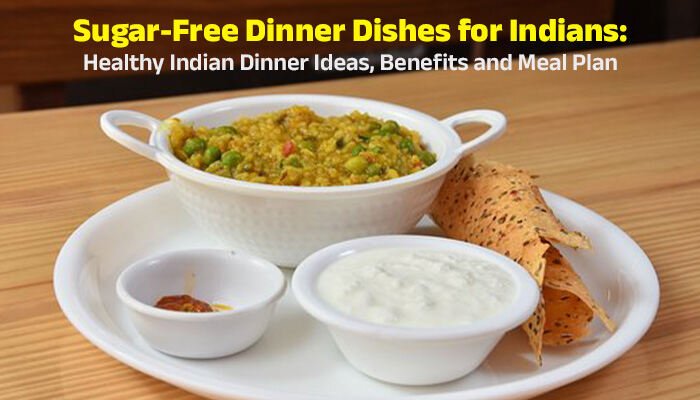
Dinner is one of those meals where Indian food can be both incredibly comforting and surprisingly easy to make healthier. A simple plate of dal, roti and sabzi can be a nutritious dinner. So can vegetable khichdi with curd, idli with sambar, paneer bhurji with roti, or grilled fish with vegetables.
The challenge is that many modern dinner routines include foods and drinks with added sugar—sweetened beverages, packaged sauces, desserts, flavoured yoghurt, bakery foods and processed convenience meals. Even traditional Indian recipes may sometimes include sugar or jaggery to create a sweet-and-sour flavour. This is where sugar-free dinner dishes for Indians can make a practical difference.
However, “sugar-free” should not be misunderstood as “carbohydrate-free.” Rice, roti, dal, vegetables and whole fruits can all be part of a balanced diet. The main objective is to reduce unnecessary added or free sugars while keeping dinner nutritious, satisfying and culturally familiar.
WHO’s current healthy-diet guidance recommends a diet based on adequacy, balance, moderation and diversity, with minimally processed foods, vegetables, fruits, pulses and whole grains forming important parts of the diet. It recommends limiting free sugars to less than 10% of total energy intake, with less than 5% potentially providing additional health benefits.
For Indian families, this does not require abandoning traditional cuisine. In many cases, it simply means cooking familiar dishes with less added sugar and building the dinner plate around vegetables, pulses, suitable protein and appropriate portions of grains.
What Does “Sugar-Free Dinner” Actually Mean?
In everyday use, people often call a dish “sugar-free” when no table sugar has been added. From a nutrition perspective, however, it is useful to distinguish between:
- Added sugar: Sugar, jaggery, honey or syrups deliberately added to food.
- Naturally occurring sugar: Sugar naturally present in foods such as whole fruit and milk.
- Free sugars: Added sugars plus sugars naturally present in honey, syrups and fruit juices.
WHO includes sugars added by manufacturers, cooks or consumers, as well as sugars naturally present in honey, syrups and fruit juices, within its definition of free sugars. Therefore, a practical Indian sugar-free dinner can mean:
A balanced dinner prepared without unnecessary added sugar and built around nutritious whole or minimally processed foods.
It does not mean removing rice, roti or all carbohydrates.
Why Choose Sugar-Free Dinner Dishes?
Dinner often becomes a place for “just one more” sweet food. For example:
Dinner → sweetened drink → dessert → sweetened tea
The actual meal may be nutritious, but the extras can increase the day’s overall free-sugar intake. Replacing these extras with water, unsweetened beverages, fruit, vegetables and balanced meals can help create a more nutritious eating pattern.
WHO states that healthy diets should be diverse and should primarily include foods such as vegetables, fruits, legumes, nuts and whole grains while limiting foods high in free sugars, unhealthy fats and sodium.
Key Features of a Healthy Sugar-Free Indian Dinner
A good dinner does not need to be complicated.
| Feature | Practical approach |
|---|---|
| No unnecessary added sugar | Avoid adding sugar to everyday savoury dishes |
| Protein included | Add dal, beans, paneer, eggs, fish, chicken or tofu |
| Vegetables included | Add one or more seasonal vegetables |
| Suitable carbohydrates | Use roti, rice, millets, dalia, etc. according to needs |
| Fibre-rich foods | Include vegetables, pulses and suitable whole grains |
| Moderate portions | Avoid automatically taking oversized servings |
| Hydration | Make water the default drink |
| Homemade where possible | Control sugar, salt and ingredients |
| Regional variety | Use Gujarati, Punjabi, South Indian, Bengali and other dishes |
| Flexible approach | Keep special desserts for occasional occasions |
1. Sugar-Free Dal Dishes for Dinner
Dal is one of the easiest foundations for a sugar-free Indian dinner. Popular choices include:
- Moong dal
- Masoor dal
- Toor dal
- Chana dal
- Urad dal
- Mixed dal
- Dal palak
- Dal tadka
- Dal fry
A simple dinner could be:
Dal + roti + vegetable sabzi + cucumber
There is usually no need to add sugar to ordinary dal. For flavour, use:
- Cumin
- Garlic
- Ginger
- Tomato
- Turmeric
- Coriander
- Curry leaves
- Green chilli
- Lemon
These ingredients can create plenty of flavour without relying on added sweetness.
2. Sugar-Free Khichdi
Khichdi is one of the most practical Indian dinner dishes. A basic version can combine:
- Rice or another suitable grain
- Moong dal
- Carrot
- Peas
- Beans
- Spinach
- Bottle gourd
- Mild spices
Why khichdi works well
It combines grains, pulses and vegetables in one pot. You can serve it with:
- Plain curd
- Cucumber
- Vegetable salad
- Homemade chutney without added sugar
Variations
Moong dal khichdi
Vegetable khichdi
Millet khichdi
Palak khichdi
Mixed vegetable khichdi
The exact ingredients and portion sizes can be adjusted according to individual dietary needs.
3. Sugar-Free Roti and Sabzi Dinner
This is perhaps one of the simplest Indian dinner combinations.
Example
2 suitable rotis + dal + bhindi + salad
or:
Roti + paneer bhurji + cucumber and tomato
or:
Roti + chana masala + mixed vegetables
The roti itself does not need sugar.
For a balanced meal, pair the roti with a protein-rich dish and vegetables rather than eating several rotis with a small amount of curry simply because the curry is tasty.
4. Sugar-Free Paneer Dinner Dishes
Paneer can be a useful protein-rich food for vegetarian Indian meals.
Try:
Paneer Bhurji
Paneer cooked with:
- Onion
- Tomato
- Capsicum
- Coriander
- Turmeric
- Cumin
Palak Paneer
Use spinach, paneer and spices without adding sugar.
Paneer Tikka
Marinate paneer with:
- Curd
- Turmeric
- Cumin
- Coriander
- Chilli
- Lemon
Vegetable Paneer Stir-Fry
Combine paneer with:
- Capsicum
- Broccoli
- Beans
- Carrot
- Onion
Serve with a suitable portion of roti or another whole-grain option.
5. Sugar-Free Rajma Dinner
Rajma is a familiar North Indian favourite. A balanced dinner can include:
Rajma + rice + cucumber salad
or:
Rajma + roti + mixed vegetables
Avoid adding sugar or jaggery to the gravy simply to create sweetness.
Instead, build flavour using:
- Onion
- Tomato
- Ginger
- Garlic
- Cumin
- Coriander
- Garam masala
6. Sugar-Free Chole Dinner
Chole can become a satisfying dinner when paired with vegetables and an appropriate portion of roti.
Try:
Chole + roti + cucumber salad
or:
Chole + vegetable salad + plain curd
Homemade chole also allows you to control the amount of oil, salt and added sugar.
7. Sugar-Free Indian Vegetable Dinner Dishes
Vegetables should have a regular place on the dinner table. Examples include:
- Bhindi masala
- Baingan bharta
- Lauki sabzi
- Tori sabzi
- Gobi matar
- Beans poriyal
- Palak
- Methi sabzi
- Cabbage sabzi
- Pumpkin sabzi
- Mixed vegetable curry
- Carrot and peas
- Vegetable stir-fry
Some vegetables, such as pumpkin and carrots, naturally taste sweeter. There is no need to add sugar simply because the recipe is traditionally prepared that way.
8. Sugar-Free Gujarati Dinner Dishes
Gujarati cuisine offers plenty of options, although some traditional preparations intentionally combine sweet, salty and sour flavours.
Sugar-free Gujarati dinner ideas
| Dish | Practical pairing |
|---|---|
| Gujarati dal | Roti + vegetable sabzi |
| Vegetable khichdi | Plain curd + salad |
| Undhiyu | Roti + salad |
| Handvo | Plain curd + vegetable salad |
| Thepla | Curd + vegetable sabzi |
| Methi thepla | Plain curd + vegetables |
| Dal dhokli | Vegetable salad |
| Sev tameta | Roti + dal |
| Mixed vegetable shaak | Roti + dal |
| Moong khichdi | Curd + cucumber |
Gujarati dal traditionally has a sweet-sour profile. You can reduce or omit added sugar or jaggery and use tomato, lemon or other flavouring ingredients to create balance.
The objective is not to make traditional food taste completely different. It is to reduce unnecessary sweetness while preserving the dish’s character.
9. Sugar-Free South Indian Dinner Dishes
South Indian cuisine provides many naturally savoury dinner options.
Idli and Sambar
A simple combination of:
Idli + sambar + chutney
can work well as a dinner.
Dosa and Sambar
Try:
Vegetable dosa + sambar + chutney
Vegetable Uttapam
Top uttapam with:
- Onion
- Tomato
- Capsicum
- Coriander
Adai
Adai made with different pulses can be served with chutney or vegetables.
Ven Pongal
Savoury pongal can be paired with sambar and vegetables.
Rasam Rice
Rasam rice with vegetables and a protein-rich side can form a simple traditional meal.
10. Sugar-Free Maharashtrian Dinner Ideas
Indian regional cuisine provides many naturally savoury dishes. Examples include:
- Vegetable bhakri
- Pithla
- Usal
- Misal-style sprouts preparation without sweetened toppings
- Matki usal
- Vegetable bhaji
- Dal
- Thalipeeth
- Moong usal
A balanced dinner might be:
Bhakri + pithla + vegetable + salad
or:
Thalipeeth + plain curd + vegetable salad
11. Sugar-Free Bengali Dinner Ideas
Traditional Bengali food also offers many savoury combinations. Examples include:
- Dal
- Shukto
- Mixed vegetable preparations
- Fish curry
- Cholar dal
- Lau ghonto
- Moong dal
- Vegetable tarkari
A dinner could be:
Rice + dal + vegetable + fish
or:
Roti + dal + vegetable curry
The same principle applies: reduce unnecessary added sugar while keeping the meal culturally familiar.
12. Sugar-Free Punjabi Dinner Dishes
Punjabi cuisine offers numerous protein-rich and vegetable-based choices.
Try:
- Rajma
- Chole
- Dal makhani
- Palak paneer
- Baingan bharta
- Sarson-style vegetable dishes
- Mixed vegetable sabzi
- Paneer bhurji
- Tandoori chicken
- Grilled fish
Restaurant versions may contain more butter, cream or oil than homemade versions, so home preparation can make it easier to control the overall meal.
13. Sugar-Free Non-Vegetarian Dinner Ideas
A sugar-free diet does not need to be vegetarian. Suitable dinner dishes can include:
Egg curry
Eggs cooked in a tomato, onion and spice-based gravy.
Chicken curry
Prepare chicken with:
- Tomato
- Onion
- Ginger
- Garlic
- Spices
without adding sugar.
Grilled chicken
Serve with:
- Vegetables
- Salad
- Roti
Fish curry
Use spices, tomato, tamarind or other suitable ingredients instead of added sugar where possible.
Fish fry
A homemade, lightly cooked version can be paired with vegetables and an appropriate carbohydrate source.
14. Sugar-Free Dinner Salads
A salad can add freshness, crunch and variety.
Simple Indian Kachumber
Use:
- Cucumber
- Tomato
- Onion
- Coriander
- Lemon
Sprouts Salad
Use:
- Moong sprouts
- Cucumber
- Carrot
- Tomato
- Coriander
- Lemon
Chickpea Salad
Use:
- Boiled chickpeas
- Cucumber
- Tomato
- Onion
- Lemon
- Coriander
Paneer Salad
Combine:
- Paneer
- Lettuce or suitable greens
- Cucumber
- Tomato
- Capsicum
Avoid sweet bottled dressings when trying to reduce added sugar.
15. Sugar-Free Indian Soups for Dinner
Soup can complement a dinner, particularly when prepared at home. Good options include:
- Tomato soup
- Vegetable soup
- Spinach soup
- Mushroom soup
- Lentil soup
- Mixed vegetable soup
- Chicken soup
- Clear vegetable soup
Be careful with packaged soup mixes, as they can contain added ingredients, sodium and sometimes sugar. Homemade soup gives you much more control.
16. Sugar-Free Dinner Dishes for Weight Management
People often associate “sugar-free” with weight loss. But removing sugar alone does not automatically make a meal low-calorie. For example:
- A deep-fried snack can contain no added sugar but still be energy-dense.
- A large portion of creamy paneer can contain little sugar but considerable calories.
- Large quantities of ghee can increase total energy intake.
- A huge serving of rice can still contribute substantial energy even without added sugar.
Therefore, a weight-conscious dinner should focus on overall energy balance and food quality, not just sugar.
A practical plate can include:
Vegetables + protein-rich food + appropriate grain/staple + healthy fat in a sensible amount.
17. Sugar-Free Dinner Dishes for People With Diabetes
People with diabetes often search for “sugar-free dinner recipes,” but the term can create confusion. A dish without added sugar can still contain carbohydrates. For example:
- Rice
- Roti
- Dosa
- Idli
- Poha
- Potatoes
- Dal
- Beans
all contribute carbohydrates to varying degrees.
Therefore, people with diabetes need to consider the overall carbohydrate amount, portion size, fibre, protein, physical activity and medications or insulin.
Example dinner ideas
Option 1: Roti + dal + vegetables + salad
Option 2: Paneer + vegetables + suitable roti portion
Option 3: Fish + vegetables + suitable rice portion
Option 4: Moong chilla + vegetable filling + curd
Option 5: Vegetable khichdi with an appropriate portion and protein-rich side
A diabetes meal plan should be individualised with a healthcare professional, particularly when medication or insulin is involved.
18. Sugar-Free Dinner Dishes for Children
Children need adequate energy and nutrients for growth, so dinner should not become an overly restrictive “diet meal.” Good options include:
- Vegetable khichdi
- Dal and rice
- Roti and dal
- Paneer bhurji and roti
- Egg curry and rice
- Vegetable dosa and sambar
- Idli and sambar
- Vegetable pulao with curd
For children, focus on less added sugar rather than calorie restriction. WHO notes that healthy dietary behaviours developed during childhood and adolescence can extend into adulthood.
19. Sugar-Free Dinner Dishes for Older Adults
Older adults may have different nutritional needs depending on their health and activity levels. Useful options can include:
- Soft vegetable khichdi
- Dal
- Moong dal
- Vegetable soup
- Soft-cooked vegetables
- Paneer dishes
- Fish
- Egg preparations
- Roti with dal and vegetables
For people with dental difficulties, softer preparations may be easier to eat. For those with diabetes, kidney disease or other medical conditions, individual dietary advice is important.
20. Seven-Day Sugar-Free Indian Dinner Plan
Here is a practical sample dinner plan.
| Day | Dinner | Side |
|---|---|---|
| Monday | Roti + dal + bhindi | Cucumber salad |
| Tuesday | Vegetable khichdi | Plain curd |
| Wednesday | Rajma + rice | Mixed salad |
| Thursday | Paneer bhurji + roti | Sauteed vegetables |
| Friday | Dosa + sambar | Vegetable chutney |
| Saturday | Chole + roti | Cucumber and tomato |
| Sunday | Grilled fish/chicken or paneer | Vegetables + suitable grain |
This is an illustrative meal plan rather than a medical diet prescription. You can replace dishes according to regional preferences and ingredient availability.
21. Sugar-Free Dinner Plate Formula
One easy way to build dinner is to think in terms of food categories rather than specific recipes.
Step 1: Choose a protein source
For example:
- Dal
- Rajma
- Chole
- Paneer
- Eggs
- Fish
- Chicken
- Tofu
Step 2: Add vegetables
Choose one or two:
- Bhindi
- Gobi
- Beans
- Palak
- Lauki
- Carrot
- Cabbage
- Mixed vegetables
Step 3: Choose a carbohydrate source
For example:
- Roti
- Rice
- Dalia
- Millet
- Khichdi
- Dosa
- Idli
Step 4: Add a suitable side
- Plain curd
- Salad
- Chaas without added sugar
This creates hundreds of possible combinations.
22. Sugar-Free Indian Dinner Combinations
| Protein | Vegetable | Carb | Complete meal |
|---|---|---|---|
| Dal | Bhindi | Roti | Dal + bhindi + roti |
| Rajma | Cucumber | Rice | Rajma rice + salad |
| Paneer | Spinach | Roti | Palak paneer + roti |
| Chole | Mixed vegetables | Roti | Chole + sabzi + roti |
| Egg | Beans | Rice | Egg curry + rice + beans |
| Fish | Gobi | Roti | Fish + gobi + roti |
| Chicken | Salad | Rice | Chicken + rice + salad |
| Tofu | Mixed vegetables | Millet | Tofu + vegetables + millet |
23. What to Drink With a Sugar-Free Dinner?
The easiest answer is often:
Water.
Other suitable choices may include:
- Unsweetened chaas
- Plain milk where appropriate
- Unsweetened lassi
- Lemon water without sugar
Try to limit:
- Cola
- Sweetened packaged beverages
- Sweetened fruit drinks
- Syrups
- Sweetened iced tea
- Sweetened milkshakes
WHO specifically recommends limiting sugary drinks because they can contribute free sugars without providing the same nutritional value as whole foods.
24. Should Fruit Be Avoided at Dinner?
Not necessarily. There is no general rule that fruit must not be eaten at night. A whole fruit can fit into a balanced diet. Examples include:
- Guava
- Apple
- Orange
- Papaya
- Pear
- Seasonal fruit
However, people with specific medical conditions may need individual guidance about carbohydrate portions or timing. The bigger concern for a sugar-conscious diet is usually added and free sugar, not eliminating nutritious whole fruit.
25. Sugar-Free Dinner Does Not Mean Low-Carb Dinner
This distinction is particularly important in India. A dinner can be free of added sugar while still containing:
- Rice
- Roti
- Dal
- Vegetables
- Fruit
WHO notes that carbohydrates remain an important energy source and recommends that they primarily come from whole grains, vegetables, fruits and pulses.
Therefore:
Sugar-free ≠ carbohydrate-free
and
Sugar-free ≠ calorie-free.
A healthy dinner should be balanced rather than unnecessarily restrictive.
26. Indian Sugar Facts You Should Know
ICMR-NIN’s Dietary Guidelines for Indians 2024 describes consumption contributing more than 5% of total daily energy, or around 25 g/day based on a 2,000-kcal reference diet, as “high” sugar. It states that limiting sugar to 25 g/day is better for health and notes that added sugar can be eliminated if possible because it adds calories without meaningful nutritional value.
ICMR-NIN defines added sugars to include:
- Table sugar
- Jaggery
- Honey
- Glucose
- Fructose
- Dextrose
- Sugar syrups
This is important for Indian households because simply replacing white sugar with jaggery does not make a recipe free of added sugar.
WHO’s current guidance recommends free sugars below 10% of total energy, with below 5% potentially providing additional health benefits. On a 2,000-kcal reference diet, those levels correspond to approximately 50 g and 25 g respectively. These are reference values, not universal individual targets.
27. Indian Nutrition Facts and Why Dinner Quality Matters
India’s nutrition situation is changing, with undernutrition and micronutrient deficiencies existing alongside overweight and obesity.
The Comprehensive National Nutrition Survey (CNNS 2016–2018) found that overweight prevalence, including obesity, ranged from 1.6% among children aged 0–4 to 4.8% among adolescents aged 10–19 in a later analysis of the survey data.
Another analysis of the CNNS reported overweight or obesity in approximately:
- 2.69% of preschool children
- 4.18% of school-age children
- 4.99% of adolescents
These figures come from the 2016–2018 survey and should not be interpreted as current 2026 prevalence estimates.
The lesson is not that everyone should eat a restrictive dinner. The lesson is that Indian families benefit from paying attention to overall food quality, variety, portion awareness and regular consumption of nutritious foods.
28. Benefits of Sugar-Free Dinner Dishes
1. Helps Reduce Added Sugar
Replacing sweetened drinks, desserts and sweetened packaged foods can reduce free-sugar exposure.
2. Supports Better Dental Health
WHO identifies free-sugar consumption as the most common risk factor for dental caries and recommends keeping free sugars below 10% of energy, ideally below 5%.
3. Encourages More Nutritious Foods
When sugary foods are reduced, dinner can make more room for:
- Vegetables
- Pulses
- Protein
- Whole grains
- Salad
- Plain dairy
4. Supports Dietary Variety
Indian cuisine provides hundreds of possible combinations without requiring added sugar.
5. Can Improve Meal Quality
A dinner built around vegetables, pulses and suitable protein is generally more nutritionally useful than a meal dominated by processed sweet foods.
6. Makes Family Eating More Sustainable
Traditional dishes can remain part of the routine, which makes dietary changes easier to maintain.
7. Helps Establish Healthier Habits
Reducing unnecessary sweetness at dinner can help make water and savoury whole foods more normal everyday choices.
These are benefits of an overall healthy dietary pattern rather than guarantees produced by eliminating sugar alone.
29. How to Make Sugar-Free Indian Dinner Taste Delicious
Many people worry that removing sugar will make food bland. It does not have to. Build flavour using:
Spices
- Cumin
- Coriander
- Turmeric
- Black pepper
- Cardamom
- Cinnamon
- Garam masala
Fresh ingredients
- Ginger
- Garlic
- Onion
- Tomato
- Green chilli
Herbs
- Coriander
- Mint
- Curry leaves
- Fenugreek
Acidity
- Lemon
- Tamarind
- Tomato
- Amchur
Texture
- Roasted nuts
- Seeds
- Fresh vegetables
- Toasted spices
Indian cuisine already has a huge flavour palette. Sugar is only one possible component.
30. How to Remove Sugar From Traditional Dinner Recipes
Some Indian recipes use sugar or jaggery to balance acidity. Instead of removing it blindly, try adjusting the recipe.
First, reduce the quantity
If a recipe calls for a large amount, use less.
Second, increase natural flavour
Use:
- Tomato
- Lemon
- Tamarind
- Spices
- Herbs
Third, taste before adding sugar
Sometimes the dish does not actually need it.
Fourth, consider the entire meal
A mildly sweet chutney alongside a savoury meal is different from consuming a large sweetened beverage and dessert every night.
31. Foods to Limit at a Sugar-Free Dinner
You do not have to ban these foods, but they are better kept occasional rather than becoming automatic everyday dinner items.
| Food | Better approach |
|---|---|
| Soft drinks | Choose water |
| Sweetened juice | Choose whole fruit |
| Sweetened yoghurt | Choose plain curd |
| Sweet sauces | Use small amounts or homemade alternatives |
| Desserts | Keep portions modest and occasional |
| Sweet bakery products | Choose savoury homemade options |
| Packaged sweet drinks | Prefer water or unsweetened drinks |
| Sugary cereal | Choose a savoury whole-food dinner |
32. A Simple Weekly Dinner Rotation
Instead of deciding what to cook every evening, create a weekly rotation.
Monday — Dal Night
Dal + roti + vegetable
Tuesday — Rajma/Chole Night
Rajma or chole + rice/roti + salad
Wednesday — Paneer Night
Paneer + vegetables + roti
Thursday — South Indian Night
Idli/dosa + sambar + chutney
Friday — Khichdi Night
Vegetable khichdi + curd
Saturday — Non-Vegetarian Night
Fish/chicken/eggs + vegetables + suitable grain
Sunday — Family Meal
Choose a traditional family favourite and prepare it with less unnecessary sugar. This simple system makes meal planning easier and creates variety.
33. Frequently Asked Questions
What are the best sugar-free dinner dishes for Indians?
Some practical choices include dal with roti and vegetables, vegetable khichdi, rajma rice, chole with roti, paneer bhurji, palak paneer, idli with sambar, dosa with vegetables, grilled fish with vegetables and egg curry with rice.
Can I eat rice during a sugar-free dinner?
Yes. Rice is not the same thing as added sugar. The appropriate portion depends on individual energy needs, health goals and the rest of the meal.
Can I eat roti at night?
Yes. Roti can be part of a balanced dinner. A suitable portion can be paired with dal, vegetables, paneer, eggs or another protein source.
Is jaggery better than sugar?
Jaggery is still an added sugar when used as a sweetener. ICMR-NIN specifically includes jaggery among added sugars.
Can diabetics eat sugar-free dinner dishes?
They can often eat many of these dishes, but “sugar-free” does not mean “carbohydrate-free.” Rice, roti, dal and other foods contribute carbohydrates. People with diabetes should follow an individualised plan from their healthcare professional.
Can I eat fruit after dinner?
For most people, whole fruit can be part of a balanced diet. There is no general rule requiring fruit to be avoided at night.
Is sugar-free dinner good for weight loss?
Reducing added sugar can be useful as part of an overall healthy eating pattern, but weight management depends on total energy intake, food quality, physical activity and individual factors. A sugar-free meal is not automatically low-calorie.
What should I drink with dinner?
Water is the simplest everyday choice. Unsweetened chaas or other suitable unsweetened beverages can also be included.
Can children eat sugar-free dinner dishes?
Yes, children can enjoy nutritious family meals prepared with little or no added sugar. However, growing children need adequate energy and nutrients, so dinner should not become an overly restrictive diet.
Are sugar-free packaged foods healthy?
Not necessarily. “Sugar-free” does not automatically mean a product is nutritious. Check the full ingredient list and nutrition information.
How can I make Gujarati dishes sugar-free?
Reduce or omit added sugar or jaggery where practical and use ingredients such as tomato, lemon, tamarind and spices to create the desired sweet-sour balance.
Can I eat Indian sweets occasionally?
Yes. A sustainable approach does not necessarily require completely eliminating traditional sweets. Smaller portions and occasional consumption are generally more realistic than making sweets an everyday habit.
Final Thoughts
A sugar-free dinner does not have to look like a restrictive diet meal. It can be:
Dal + roti + bhindi.
Rajma + rice + salad.
Vegetable khichdi + curd.
Paneer bhurji + roti.
Idli + sambar.
Dosa + vegetable filling.
Fish + vegetables + rice.
Egg curry + roti + salad.
These are familiar Indian foods—not complicated diet recipes.
The key is to reduce unnecessary added sugar while keeping the meal balanced and satisfying.
ICMR-NIN’s Dietary Guidelines for Indians 2024 emphasise that added sugars—including table sugar, jaggery and honey—add calories without meaningful nutritional value and recommend limiting sugar intake. WHO similarly recommends limiting free sugars to less than 10% of total energy intake, ideally below 5%, while building meals around diverse, minimally processed foods.
For Indian families, the most sustainable approach is therefore not to search for a magical “zero-sugar dinner.”
It is to make dal, vegetables, pulses, suitable grains, protein-rich foods, salads and homemade meals the everyday foundation, while keeping sugary drinks, desserts and heavily sweetened foods occasional.
That way, dinner remains something to look forward to—not something that feels like a punishment.
Health Disclaimer
This article is intended for general educational purposes and is not a substitute for personalised medical or nutritional advice. Dietary requirements vary according to age, activity level, health conditions, medications and individual nutritional needs. People with diabetes, kidney disease, food allergies, eating disorders or other medical conditions should consult a qualified healthcare professional or registered dietitian before making significant dietary changes. Children should not be placed on restrictive diets without appropriate professional guidance.